
Another Human Rights Decision Overturned


- Details
- Created on Wednesday, 15 February 2012 17:21
- Hits: 1879
There have been many instances in which the courts have curtailed the excesses of human rights tribunals across the country. This happened again today, in the case of two black lawyers who claimed they were discriminated against by a legal librarian in 2008.
The incident occurred in a courthouse lounge that was restricted to lawyers only – paralegals were not permitted. Melissa Firth, a librarian/administrator for the Peel Law Association, approached the two lawyers and asked for their identification, since she did not recognize them and thought they might be paralegals. They immediately accused her of racial profiling, and a verbal altercation ensued.
C-304 Vote Scheduled for Tomorrow
- Details
- Created on Tuesday, 14 February 2012 21:58
- Hits: 1718
 Bill C-304, “An Act to Amend the Human Rights Act” is being debated in Parliament today and is scheduled to have its first vote tomorrow evening. If you have not yet contacted your MP to support this legislation, please do so now.
The bill, introduced by MP Brian Storseth, seeks to ensure greater protection of freedom of expression in Canada by removing the government’s power to censor speech through section 13 and 54 of the Canadian Human Rights Act.
Penalizing Political Involvement
- Details
- Created on Friday, 13 January 2012 06:52
- Hits: 2901
This is just what we need – more disincentives to get involved in politics.
We can all agree that sitting on the sidelines and grousing about our politicians, without doing much about it, isn’t doing our society any favours.
Mike Del Grande doesn’t seem to be one of those individuals. His track record includes two decades of membership in organizations like the Silver Springs Community Association, the Scarborough Homeowners Alliance for Fair Taxes, and the local Neighborhood Watch program. He was awarded the Volunteer of the Year award in 1991, served as a school trustee for three terms, and has been elected to the
Yet Del Grande was rewarded for his service to his community by being hauled before a human rights tribunal.
Advertising Campaign Draws Attention to Problems With Human Rights Commissions
- Details
- Created on Wednesday, 14 December 2011 19:55
- Hits: 2004
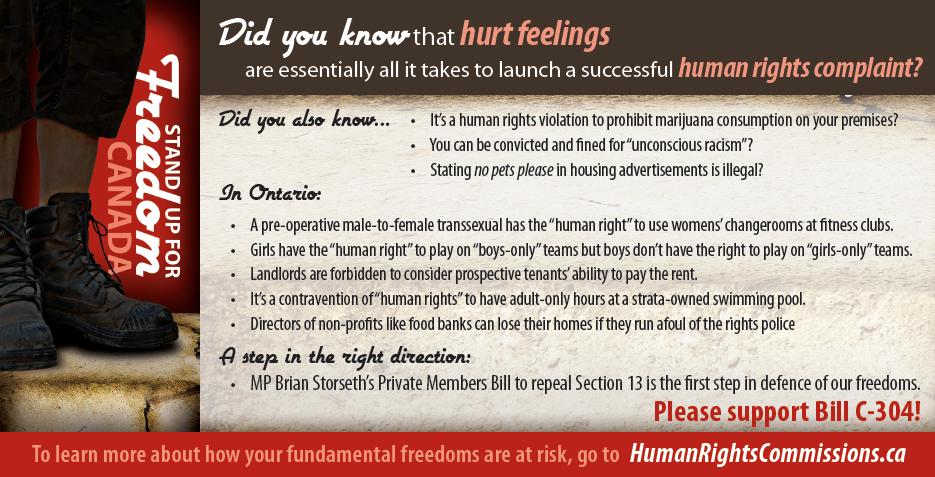
An advertisement campaign in southern Ontario
Press Release
- Details
- Created on Wednesday, 23 November 2011 16:46
- Hits: 1921
For Immediate Release – November 23, 2011 (Ottawa, ON): Stand Up For Freedom Canada calls on all members of Parliament to support Bill C-304, “An Act to Amend the Human Rights Act”. Last night, Bill C-304 was read and debated in the House of Commons. The bill, introduced by MP Brian Storseth, seeks to ensure greater protection of freedom of expression in Canada by removing the government’s power to censor speech through section 13 and 54 of the Canadian Human Rights Act.
When asked for the government’s position on Bill C-304, the Hon. Rob Nicholson, Minister of Justice and Attorney General of Canada stated that, “our government believes that section 13 is not an appropriate or effective means for combatting hate propaganda. We believe the Criminal Code is the best vehicle to prosecute these crimes.”
Support Bill C-304! Use our Easy Mail Technology Today
- Details
- Created on Tuesday, 22 November 2011 20:41
- Hits: 1948
Veganism: The Next Frontier!
- Details
- Created on Tuesday, 08 November 2011 17:03
- Hits: 1793
 National Post, Nov 8 2011: The Human Rights Tribunal of Ontario is to decide whether ethical veganism is a creed, as protected by anti-discrimination laws, in the case of a Ryerson University master’s student in social work who claims senior faculty “sabotaged” her career because of her moral equivalence of animals and humans.
Sinem Ketenci, 37, who immigrated from Turkey as a young woman and studied at Lakehead University in Thunder Bay before doing a master’s at Ryerson, alleges a senior professor disagreed with her comparison of maltreated animals with marginalized people, said the connection was “very inhuman and racist,” and pressured Ms. Ketenci’s untenured supervisor into withdrawing his recommendation of her PhD candidacy at other schools, which she called an academic “kiss of death.” Keep reading
Upholding the law, as it was written
- Details
- Created on Tuesday, 01 November 2011 15:56
- Hits: 1647
National Post Editorial, Nov 1 2011: On Friday, the Supreme Court of Canada ruled that the Canadian Human Rights Tribunal (CHRT) cannot order the reimbursement of legal costs incurred by federal human rights complainants. The court's decision may well discourage some complainants from bringing cases to the tribunal. But the unanimous decision by the justices was the legally correct one. To have found that the tribunal had the power to award costs would have amounted to judicial activism. If Parliament had wanted to give the tribunal the authority to make such awards, it could have spelled that out directly. But it didn't. Keep reading
Policing Hurt Feelings
- Details
- Created on Friday, 28 October 2011 06:46
- Hits: 2869
The various Canadian human rights codes were not necessarily designed to protect hurt feelings of designated groups. The intention was to prevent a situation in which an person was denied basic goods and services on the basis of some prejudice or another. Yet we hear again and again from editorials critical of the rights racket that the Commissions and Tribunals are indeed prosecuting individuals and organizations for hurting the feelings of others, often without any intention to do so. How did this happen?
One case that is routinely cited to justify the expansion into policing hurt feelings is from the BC Human Rights Tribunal, which is well known for their liberal interpretations and habit of stretching definitions. In Radek vs Henderson Development (Canada) and Securigard Services, an aboriginal woman claims she was mistreated by security guards at a downtown
Brian Storseth on C-304
- Details
- Created on Friday, 21 October 2011 17:39
- Hits: 1697
Stand Up for Freedom Canada commends MP Storseth for taking the lead in reforming the Canadian Human Rights Code. Send your EasyMail letter (goes to your MP, Prime Minister, Justice Minister, and Brian Storseth) in minutes.