
Watch what you post on Facebook!


- Details
- Created on Wednesday, 14 August 2013 19:40
- Hits: 2833
 A number of years ago, I once jokingly said that maybe one day even Facebook posts would be subject to Human Rights complaints. I guess I forgot to knock on wood.
Earlier this summer the Human Rights Tribunal of Ontario found a disgruntled employee guilty of racial harassment in the workplace for calling her manager a “dirty Mexican”. While that’s a mean, even racist, thing to say, I am nevertheless flabbergasted by the ruling for three reasons:
1. The employee posted this message on her private Facebook page after she got home from work. Furthermore, she never actually named her employer! Somehow that counts as “harassment in the workplace” and deserves censure by the State.
2. If the manager doesn’t like the way his employee is acting, fire her! That should be his responsibility and right. But to go whining to the State about hurt feelings, humiliation and injured dignity and then ask the State to rearrange their work schedules in order to avoid further “workplace harassment” seems downright silly. (The manager actually asks for this: see para. 13 of the decision here.) Would you like the State to sweep the floors and stock the shelves for you too, sir?
3. The third thing that blows my mind is that the Tribunal actually took the case at all. I don’t want to know how many of our tax dollars went into this complaint. Note that the complaint would first have been vetted by the Commission, using up expensive resources there, and then gone on to the Tribunal. Members of the Tribunal are paid quite well and this complaint involved a number of hearings and rulings (not to mention the cost of the recording clerk, the registrar, the rental of space, etc.) Do taxpayers really need to be spending thousands of dollars on this trivial nonsense when Ontario is struggling with an annual $36 billion deficit and a $253 billion debt??
Anyway, the lesson here is… well, watch what you post on Facebook and it’s time to either reform or scrap this expensive bureaucracy.
You kinda need evidence before ruining a corporation's reputation
- Details
- Created on Wednesday, 14 August 2013 11:42
- Hits: 2266
 The Supreme Court in B.C. had to overturn a B.C. Human Rights Tribunal ruling this week, a ruling that found a shipyard company guilty of discrimination. Why the reversal? Well, said the judge: “There was no evidence capable of proving the case of discrimination before the tribunal.”
Victoria Shipyards highly values its reputation as a fair employer with a great record of taking workplace harassment and discrimination seriously. But the Tribunal found the employer guilty of racial discrimination based on the whimsical story of a black man who claims he found a rag on his lunchbox that looked like a KKK mask. There was no corroboration of the story, and the Tribunal even admitted that the complainant was unreliable and seemed nervous and confused and that the evidence was inconsistent.
But despite this obvious and terrible lack of evidence, the Tribunal found that there was discrimination. This is a bizarre conclusion, a violation of the rule of law which calls into question the impartiality of the Tribunal.
There is a silver lining to this whole ordeal: the Supreme Court ordered the complainant to pay the legal costs in the appeal. What a great remedy! Hopefully this sends a loud and clear message to anyone who tries a shakedown of a reputable company: you better have some good evidence before trying this!
And hopefully the Tribunal heard their rebuke clearly too: basic fairness requires evidence of discrimination before a finding of guilt. A five-year-old knows that. It’s basic justice and fairness.
The human right to walk topless wherever you want
- Details
- Created on Tuesday, 13 August 2013 16:33
- Hits: 2429
 I was going to open this post by complaining about the derogation of real human rights or the continuing absurdity of Canada’s “human rights” complaints, but that line is starting to get a little repetitive (see some of the recent stories below). Basically, this lady thinks she has a government enforceable human right to walk wherever she pleases without wearing the appropriate clothing.
A few things to note in the story starring a Ms. Rebecca Anne Clark:
First, Ms. Clark was obviously able to walk around on a beach topless. She was simply stopped when she got to the main area where the young families were located. However, the periphery beach was not good enough for this exhibitionist.
Second, Ms. Clark also obviously believes the government can and should expend limited resources (time, money, human capital – that is, your and my tax dollars) in enforcing her right to flash her more intimate body parts around to everyone (including children) on the more populated area of municipal beaches. Parents of little ones can go fly a kite. Also, it should be noted that the lifeguard was NOT insisting that Ms. Clark walk around in an old-style getup like that in the picture to the left. But I digress…
Third, there is no apparent limit to Ms. Clark’s position: if there is a right to be topless in a family friendly beach area, then is there a right to be topless in restaurants, movie theatres, at a mosque, or in court? Maybe those stores that say “no shirt, no service” are discriminatory too!
I don’t really want to go too deeply into the whole equality of the sexes discussion, but my final point is this: I do find it curious that Ms. Clark thinks that in order for a woman to be equal to a man, she must become more like a man (i.e. walk around without a top on). This strikes me as being a very unfeminine, almost anti-woman, position. It seems she is denying that there might be some things that make women unique from men. If every difference between the sexes is viewed by women like Ms. Clark as a detrimental hindrance instead of a uniqueness that is worth celebrating and cherishing, I’m afraid this homogeneous approach to equality is and will be more destructive than I feared.
The diminishing of human rights continues
- Details
- Created on Monday, 12 August 2013 14:41
- Hits: 2171
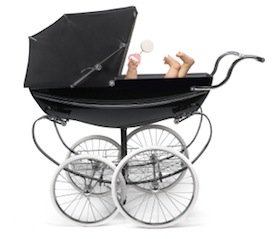 The human right to lug your bulky baby carriage wherever you darn well please, including into private establishments, has been threatened. Awful, isn’t it? How could such an assault on freedom and liberty and human rights still be possible in a progressive country such as Canada? (I hope our dear readers can note the heavy sarcasm…)
A small restaurant in Brampton has implemented a policy which does not allow baby strollers. Note: the policy does not ban babies; it bans their strollers. But that’s just not okay for this new set of parents (check out their sad, devastated faces). They are outraged, and might consider a human rights complaint for discrimination. (On the basis of what, I’m not sure. But human rights lawyer Selwyn Pieters thinks the restaurant has to accommodate strollers to the point of “undue hardship”.)
Note as well that the reason for the policy is the limited amount of room in the restaurant and thus the safety of clients is of primary concern. But for Andrea Chilcott and Jason Desroches, their baby’s right to ride in style should trump the private property rights of the restaurant owner, the safety interests of the entire staff and all other patrons of the restaurant, and the right of a business person to set standards and policies for how they decide to conduct business and on what grounds.
Here’s an idea: LEAVE THE STROLLER IN THE CAR! Grow up and stop whining. And if you really, really need that stroller to come into the restaurant with you, go to another restaurant. Obviously this restaurant would rather lose your business than put their patrons’ safety at risk. That should be their right.
This is starting to get ridiculous...
- Details
- Created on Friday, 09 August 2013 01:51
- Hits: 2433
 Not again?! This is starting to get ridiculous. Correction: it already was ridiculous; this is starting to become asinine. There is no fundamental human right to the barber of your choice!
I thought that a similar complaint in Toronto a few months back about this alleged fundamental human right of getting-a-hair-cut-by-the-barber-of-your-choice-with-or-without-their-willing-consent might have been a silly anomaly. But maybe it was a test case to see how much money can be shaken out of honest businessmen in Ontario trying to specialize in a niche market of male haircuts.
Anyway, this story should make your blood boil: Another woman, self-described as “a sex positive queer feminist activist”, thinks her right to a male haircut in a men’s only barbershop trumps a barber’s rights to private contract, to freely associate with men, to private property, to freedom of expression and to liberty (as well as the male customers' right to freedom of association).
The reason for the barber’s refusal to cut the complainant’s hair is simple: "I didn't want to cut her hair," said Phil Angemi, who's owned the Westdale Barber Shop for the past 12 years. "That's my reason."
Diatribe read by unintended recipient costs man $8,000
- Details
- Created on Thursday, 08 August 2013 15:37
- Hits: 1518
 The Quebec Human Rights Commission has ordered a man to pay “moral and punitive” damages to a woman who was begging outside a liquor store. The case, which stretches over the past three years, involves an irate customer of the SAQ liquor stores, named Delisle, who wrote a diatribe about panhandlers outside these venues, in particular a Ms. Beaumont. In his letter sent to the store, he suggested four ways in which to eradicate and kill panhandlers. Whether or not his suggestions were serious was never determined.
When the store employees showed the letter to the police, they declined to act. So, the store decided instead to show the letter to the woman who was begging. This woman filed a human rights complaint and is now $8,000 richer.
As Robyn Urback explains, civil law and criminal law declined to act in this case. “This case may have had legs in criminal court, which would have been tasked with assessing whether Delisle’s "solution" suggestions in his letter were actual threats or mere bigoted ramblings. But that's not what the human rights commission was assessing.”
And so the human rights commission, working on a different playing field with different rules, has stepped in with free expression being the casualty: hurt feelings trump free expression.
Curiously, but for the employees’ action of showing the letter to Ms. Beaumont, her feelings would never have been hurt. She would have been blissfully ignorant of the hurtful, bigoted thoughts and ideas of Mr. Delisle. Yet, the employees were not investigated, much less fined, for hurting Ms. Beaumont’s feelings. This sets a strange precedent: can private, yet hateful or bigoted communications between parties be shared without consent with outside parties, leaving the author fully liable for any ensuing “loss to dignity” experienced by those outside parties? It seems so.
But here's another scary aspect to the precedent: as noted, the person responsible for the hurt feelings (the store employee) is not prosecuted in this case. This makes it abundantly clear that the only quasi-legitimate cover for the entire modern "human rights" system - that being the deterrence of demonstrable harm - is actually a farce. The system is designed to censor and it encourages censoring and it seeks out messages to censor. As demonstrated in this case, there was no intention to prevent harm. Rather, the system encouraged harm because the only way that the employee could get the authorities involved was by initiating the harm (the hurt feelings). Kinda disgusting, don't you think?
Video Interview: How BC, AB, and SK can Stand Up for Free Speech!
- Details
- Created on Friday, 12 July 2013 18:56
- Hits: 1377
Stand Up for Freedom Canada sat down with John Carpay, president of the Justice Centre for Constitutional Freedoms, after a presentation he made for Alberta ARPA chapters in Edmonton this spring. In this video Mr. Carpay explains the work he does and the opportunity for Western Canadians to stand up for freedom by reforming their human rights codes. Watch and share!
Gator Teds vindicated: no human right to smoke weed wherever you want
- Details
- Created on Thursday, 11 July 2013 23:36
- Hits: 1773
 When this Stand Up For Freedom campaign kicked off, we reported on a number of different cases that were underway already that were just weird, like the case of Mr. Gibson and the Gator Teds restaurant. (We explained the case here; it's the second case under the heading Private Business). Here's a quick summary: Mr. Gibson has a disability and has a permit to smoke medical marijuana to ease his pain. However, he repeatedly tried to smoke his joints directly in front of the Gator Teds restaurant door and on their patio and felt that not being allowed to do so (even though patrons were complaining) was discrimination on the basis of disability. He filed a complaint with the Ontario Human Rights Commission way back in 2005 asking for $20,000 for "mental anguish". Eventually, the Commission took his case to the Tribunal for a hearing. Last week (July 4, 2013), the Tribunal ruled that there was, in fact, no discrimination. So, 8 years and tens of thousands of dollars later, Mr. Ted Kindos, the owner of Gator Teds, is vindicated. But at quite a cost. The complainant Mr. Gibson's legal fees were all paid for by the taxpayer because the Commission represented him. Mr. Kindos, a hard-working businessman, had to pay out of pocket. In a real court, Gibson would have had to pay Kindos' legal fees. Obviously it was the process that punished an innocent business man. It's time to fix your Code, Ontario!
Provincial hate speech laws are next
- Details
- Created on Tuesday, 09 July 2013 14:37
- Hits: 1389
 The National Post published an editorial on July 3rd, titled "Taking the free speech campaign to the provinces". They note that, now that the Federal hate speech provision has been repealed, those provinces with hate speech provisions should be the next to reform. Theoretically this should be possible.
The three provinces with hate speech provisions are BC, Alberta and Saskatchewan. (The NorthWest Territories also has a hate speech provision.) Alberta has a strong libertarian and freedom-loving history and constituency and is home to two right of centre parties that are on record as being at least interested in reforming their Human Rights Act. Saskatchewan currently has a very popular Conservative government, so it should be possible to change that law too. If successful, that would effectively leave BC as the sole province with a hate speech provision, meaning those citizens would have a very limited freedom of expression when compared to all other Canadians. How long would that last? So, indeed, let's take the campaign to the provinces. Stand up for freedom, Canada!
When Being Offensive Becomes Discrimination
- Details
- Created on Saturday, 29 June 2013 18:05
- Hits: 1182
 On June 19, the Supreme Court of BC released a troubling judgment in a human rights appeal. A few years ago, we reported on the case of the not-too-funny comic who threw out offensive slurs at a couple of hecklers who were disturbing his show. Those hecklers (two lesbians) were so offended they complained to the human rights commission in BC and won a $15,000 award against the comedian and an additional $7,500 award for damage to dignity against the bar where the comedian was performing. The real court has upheld the tribunals findings and cost awards. The judge has conflated "offensive comments" with "discrimination" leaving us with the question, what else might be considered discrimination? A constitutional lawyer, Albertos Polizogopoulos, penned a blog post about this worrying precedent here. It's well worth a read. Also, see Ezra Levant's interview of Chris Schafer here. Hopefully, this case gets appealed one more time.
I add this caveat: If any criminal activity took place in the dispute between the comedian and the hecklers (breaking of sunglasses, pushing, throwing water in the face, etc.) then that may constitute assault, and should be dealt with accordingly, that is, through the criminal law process. The Human Rights Tribunal is ill-equipped to adjudicate criminal law matters.