



Main Menu
Resources
Facebook Fans

Latest News
Previous
Next
 Barbarian-phobic
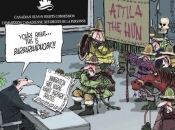
We couldn't resist posting this one! Check out the editorial cartoon by Brian Gable, from the Globe and Mail:
Read more
Barbarian-phobic
We couldn't resist posting this one! Check out the editorial cartoon by Brian Gable, from the Globe and Mail:
Read more
 Supreme Court Ruling on Free Speech tomorrow!
The Supreme Court of Canada will release the long-awaited decision on the Bill Whatcott case. We reported on that case when it was heard 16 months ago (click here to read up on the case). We will post the results as soon as we know what they are. In the meantime, you are on notice that whatever the decision is, we must work to eliminate t...
Read more
Supreme Court Ruling on Free Speech tomorrow!
The Supreme Court of Canada will release the long-awaited decision on the Bill Whatcott case. We reported on that case when it was heard 16 months ago (click here to read up on the case). We will post the results as soon as we know what they are. In the meantime, you are on notice that whatever the decision is, we must work to eliminate t...
Read more
 But some animals are more equal than others
From the National Post: The Ontario Human Rights Tribunal has dismissed a complaint against a women’s studies professor who fought a Catholic volunteerism program at Brock University, saying [the professor's] anti-Catholic comments were offensive, but not akin to discrimination.
Although the complainant was treated differently due to his...
Read more
But some animals are more equal than others
From the National Post: The Ontario Human Rights Tribunal has dismissed a complaint against a women’s studies professor who fought a Catholic volunteerism program at Brock University, saying [the professor's] anti-Catholic comments were offensive, but not akin to discrimination.
Although the complainant was treated differently due to his...
Read more
 Alberta court of appeal dismisses appeal against Boisson
The Calgary Sun reports that, after a legal fight lasting nearly 11 years over a letter to the editor, Prof. Darren Lund is disappointed Alberta’s Court of Appeal dismissed his case, allowing “free reign to hate mongers”. Rev. Stephen Boisson is the minister who, after writing and publishing this letter in his local paper was fined and o...
Read more
Alberta court of appeal dismisses appeal against Boisson
The Calgary Sun reports that, after a legal fight lasting nearly 11 years over a letter to the editor, Prof. Darren Lund is disappointed Alberta’s Court of Appeal dismissed his case, allowing “free reign to hate mongers”. Rev. Stephen Boisson is the minister who, after writing and publishing this letter in his local paper was fined and o...
Read more
 Head of Canadian Human Rights Tribunal on Stress Leave
The working atmosphere of the CHRT begs the question - if it needs to be investigated for harassment among other things, how can it be in charge of determining "human rights" offenses for the nation?
Selection from the Vancouver Sun, April 23 2012: The Ottawa Citizen has also learned that the Office of the Public Sector Integrity Commis...
Read more
Head of Canadian Human Rights Tribunal on Stress Leave
The working atmosphere of the CHRT begs the question - if it needs to be investigated for harassment among other things, how can it be in charge of determining "human rights" offenses for the nation?
Selection from the Vancouver Sun, April 23 2012: The Ottawa Citizen has also learned that the Office of the Public Sector Integrity Commis...
Read more
 Press Release
For Immediate Release – November 23, 2011 (Ottawa, ON): Stand Up For Freedom Canada calls on all members of Parliament to support Bill C-304, “An Act to Amend the Human Rights Act”. Last night, Bill C-304 was read and debated in the House of Commons. The bill, introduced by MP Brian Storseth, seeks to ensure greater protection of free...
Read more
Press Release
For Immediate Release – November 23, 2011 (Ottawa, ON): Stand Up For Freedom Canada calls on all members of Parliament to support Bill C-304, “An Act to Amend the Human Rights Act”. Last night, Bill C-304 was read and debated in the House of Commons. The bill, introduced by MP Brian Storseth, seeks to ensure greater protection of free...
Read more
- 1
- 2
- 3
- 4
- 5
- 6
- 7
- 8
- 9
- 10
- 11
- 12
Barbarian-phobic
We couldn't resist posting this one! Check out the editorial cartoon by Brian Gable, from the Globe and Mail:
Read more
Supreme Court Ruling on Free Speech tomorrow!
The Supreme Court of Canada will release the long-awaited decision on the Bill Whatcott case. We reported on that case when it was heard 16 months ago (click here to read up on the case). We will post the results as soon as we know what they are. In the meantime, you are on notice that whatever the decision is, we must work to eliminate t...
Read more
But some animals are more equal than others
From the National Post: The Ontario Human Rights Tribunal has dismissed a complaint against a women’s studies professor who fought a Catholic volunteerism program at Brock University, saying [the professor's] anti-Catholic comments were offensive, but not akin to discrimination.
Although the complainant was treated differently due to his...
Read more
Alberta court of appeal dismisses appeal against Boisson
The Calgary Sun reports that, after a legal fight lasting nearly 11 years over a letter to the editor, Prof. Darren Lund is disappointed Alberta’s Court of Appeal dismissed his case, allowing “free reign to hate mongers”. Rev. Stephen Boisson is the minister who, after writing and publishing this letter in his local paper was fined and o...
Read more
Why Do We Still Have Hate Speech Laws?
While not specifically dealing with the Human Rights Commissions, Tribunals and Codes, Andrew Coyne tackles the idea of hate speech laws and why they don't work in a functioning democracy. He makes a number of good points which our provinces should take to heart in evaluating their own human rights codes.
Andrew Coyne National Post July ...
Read more
Head of Canadian Human Rights Tribunal on Stress Leave
The working atmosphere of the CHRT begs the question - if it needs to be investigated for harassment among other things, how can it be in charge of determining "human rights" offenses for the nation?
Selection from the Vancouver Sun, April 23 2012: The Ottawa Citizen has also learned that the Office of the Public Sector Integrity Commis...
Read more
Did tribunal exceed its authority? Supreme Court of Canada will decide Thursday if human rights decision should be upheld
Vancouver Sun, March 21 2012: On Thursday, the Supreme Court of Canada will hear the appeal of Moore v. British Columbia Ministry of Education. Among other things, this case will decide whether the B.C. Human Rights Tribunal has the authority to dictate what services the B.C. government provides.
Jeffrey Moore started grade school in...
Read more
A right to special treatment
Pamela Howson clearly knows how the human rights system works.
First, claim membership of a “protected” group. In Ontario, their Human Rights Code includes protection on the basis of “family status”, which has been interpreted by the provincial tribunal as granting privileged status to mothers with children. Ms. Howson has three children...
Read more
Press Release
For Immediate Release – November 23, 2011 (Ottawa, ON): Stand Up For Freedom Canada calls on all members of Parliament to support Bill C-304, “An Act to Amend the Human Rights Act”. Last night, Bill C-304 was read and debated in the House of Commons. The bill, introduced by MP Brian Storseth, seeks to ensure greater protection of free...
Read more
Support Bill C-304! Use our Easy Mail Technology Today
It only takes a few minutes to use this site's Easy Mail technology to send a letter to your MP, along with the Justice Minister, in support of a much-needed law to reform the Canadian Human Rights Act. It is free, customizable, and you won't get any unwanted newsletter or donation requests. We provide this for the sake of FREEDOM. Click ...
Read more
Policing Hurt Feelings
The various Canadian human rights codes were not necessarily designed to protect hurt feelings of designated groups. The intention was to prevent a situation in which an person was denied basic goods and services on the basis of some prejudice or another. Yet we hear again and again from editorials critical of the rights racket that...
Read more
Non-Muslims Need Not Apply
The National Post recently ran a story about housing advertisements in Ontario that are clearly running afoul of the Ontario Human Rights Commission’s policy. Specifically, the reporter was able to find several ads in which it was stated, “non-Muslims need not apply” or some variation thereof.
When the reporter called the OHRC to ask abo...
Read more
Poll
Paste Into Your Blog
| Talking Points – for meeting with elected representatives |
 |
 |
 |


Meeting with your provincial and federal elected representatives to discuss the human rights commissions is perhaps the most effective thing you can do to stand up for freedom. Here are some pointers for organizing a meeting, as well as talking points that you can use. Setting up a meeting:
Meeting pointers:
After the meeting:
Be sure to meet separately with both your provincial and federal representative! Helpful Points:
Problems with HRC’s and HRT’s:
Click here to see the options (Reform, Replace, Remove) |